
North Las Vegas City Directory Collections
North Las Vegas directory research begins with a clear limit: no official source located a continuous, year-by-year directory run for the city. The useful material is regional. Official Las Vegas historic surveys identify particular volumes and research methods, while the Library District, UNLV Special Collections, and the Nevada State Library and Archives offer places to confirm holdings. Treat each hit as evidence for the stated year and geography. A Las Vegas listing may be relevant to North Las Vegas, but a postal label or city line still needs checking.
| Collection | Located years | Repository lead | Best use |
|---|---|---|---|
| Luskey’s Las Vegas Criss-Cross City Directory | 1956, 1957, 1959, 1966, 1967 | Nevada State Museum Las Vegas is cited by an official survey | Reverse address-to-occupant leads |
| Las Vegas city directory reviewed by survey researchers | 1943-44 | UNLV and Cahlan sources cited by the Huntridge survey | Full-volume name and address checking |
| Las Vegas City Directory | 1954 | Historic-survey bibliography and local repositories | Person-to-place continuity |
| Library District genealogy databases | Varies by database and title | Library branches, catalog, and licensed databases | Directories, newspapers, obituaries, and census |
| UNLV Special Collections holdings | Collection-specific | Digital portal and archival finding aids | Photographs, appraisals, and development context |
The table records verified leads, not a claim that every year contains a separate North Las Vegas edition. Ask library reference staff to check print, microform, catalog, and licensed-database holdings for the exact title and year. That step is especially important where the closest item is a regional volume.
Note: A directory absence can mean an unlisted household, a different city label, or a missing volume rather than a confirmed move.
North Las Vegas Criss-Cross Years
The Charleston Heights historic-survey bibliography identifies Luskey reverse directories for 1956, 1957, 1959, 1966, and 1967. A criss-cross volume usually starts with an address, then points toward an occupant or business entry. It is the most direct historical route when the question begins with a street number. Record the volume year, full address, page, and any abbreviation key before drawing a conclusion about a North Las Vegas household.
Use the name section after finding an address entry. Compare the street number, spouse notation, occupation or business affiliation, and city designation. A same-name result is weak by itself. The City of Las Vegas surveys make these Luskey years useful regional evidence, yet they do not establish a complete North Las Vegas publishing run or prove that every location lay inside the same municipal boundary.
North Las Vegas Directory Milestones
Regional record history helps explain why historical volumes need careful labels. Clark County was organized in 1909, and North Las Vegas incorporated in 1946. County and regional records can therefore predate the city name used in a later directory. The explicit directory evidence starts with a documented full-volume review, not with a verified first North Las Vegas directory.
| 1909 | Clark County’s modern county record trail begins. |
|---|---|
| 1943-44 | An official Las Vegas historic survey documents a full city-directory review. |
| 1946 | North Las Vegas incorporated, so earlier records may use county or regional labels. |
| 1954 | An official historic survey cites a Las Vegas City Directory entry. |
| 1956-1967 | Five Luskey criss-cross years are explicitly identified in an official survey. |
The last row is not a last-publication date. It is simply the last Luskey year the official survey named. No verified source supplied a continuous first-to-last printed-year list for North Las Vegas, so a reference request remains the practical way to reduce the gap.
Reading a North Las Vegas City Directory
A historical volume is easier to use when every part of an entry stays together. Do not copy a name without the page number, year, source title, and abbreviation key. The local-history evidence does not reproduce a complete copyrighted directory scan, but it supports a field inventory for checking a real entry against the title’s own conventions.
| Name | Surname and given name, usually filed by household head or business name. |
|---|---|
| Household marker | Spouse notation, widow or widower notation, or another marker when the publisher supplied one. |
| Address | Street number, street name, unit when shown, and the printed city or township label. |
| Affiliation | Occupation or business affiliation when the particular volume includes it. |
| Cross-reference | A reverse entry, telephone convention, ownership mark, or other keyed notation when present. |
- Criss-cross directory
- A reverse-format directory arranged from address to a listed occupant or business instead of from name to address.
- Householder index
- A name-oriented list that may identify a household head, but does not prove that every person at an address was included.
- Abbreviation key
- The volume’s explanation of shorthand and symbols. Keep it with the transcription because conventions vary by title and year.
When a symbol is absent, leave it absent. A missing notation is not proof of ownership, a death, or a move. The original volume’s key controls the meaning of every mark.
North Las Vegas City Directory Research Routes
The Las Vegas-Clark County Library District genealogy service is the strongest practical starting point for directories, obituaries, newspapers, and census material. It lists HeritageHub, Ancestry Library Edition, HeritageQuest, Chronicling America, Fold3, historical newspaper resources, and other databases. Access can differ by product, library card, and in-library use, so record the database name and the date searched. The North Las Vegas Library District also offers branches, public computers, reference help, and catalog access.
Use the Library District genealogy resources to identify the collection before requesting a volume or database session.
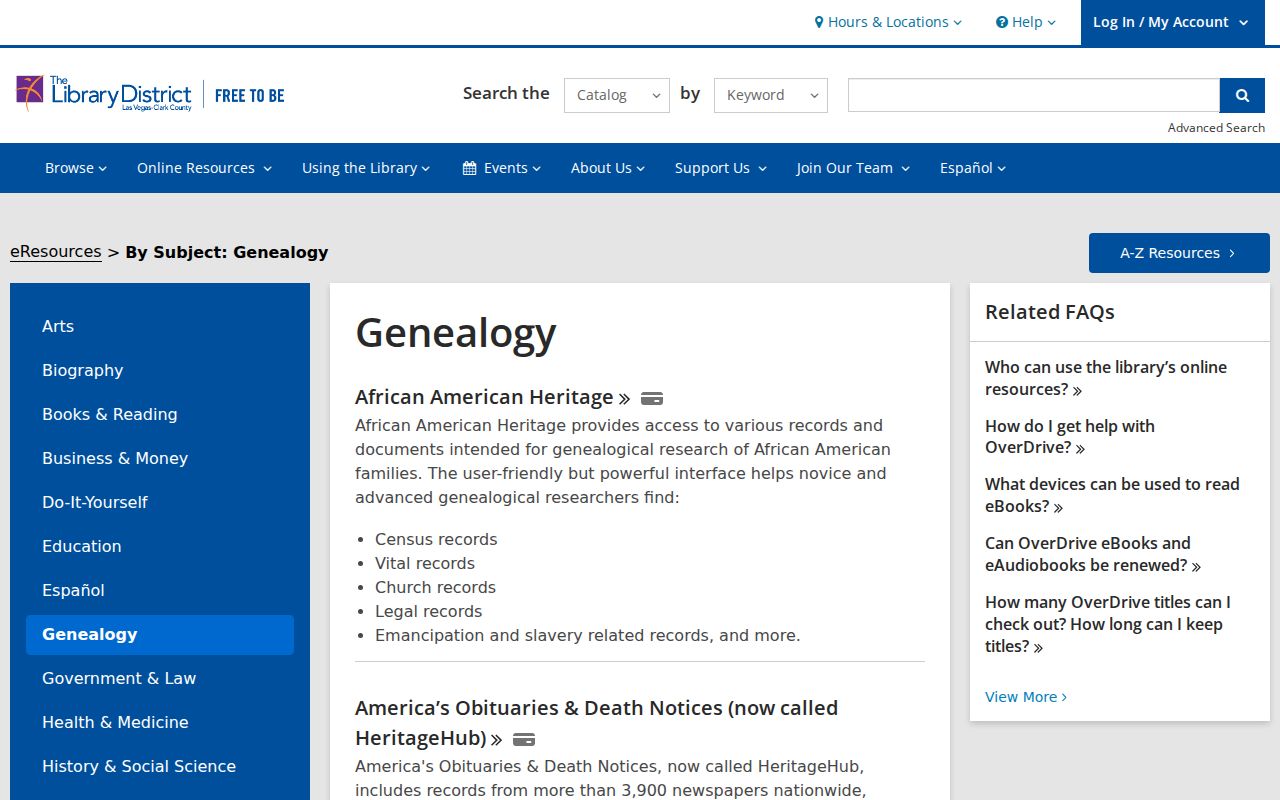
The library resource screen is a gateway to supporting evidence, not a claim that one database supplies every directory year. Reference staff can help determine whether a title is in print, microform, or a licensed collection.
UNLV Special Collections and Archives, at 4505 South Maryland Parkway in Las Vegas, provides a second research route. Its portal searches digital objects, collections, people, and organizations. The listed research-room schedule is Monday through Thursday from 9 a.m. to 7 p.m. and Friday from 9 a.m. to 5 p.m., with weekends closed. Ask for a finding aid or collection context when a city-directory lead points to a photograph, appraisal, local-government file, or ephemera item.
North Las Vegas Directory and Census Dates
Historical directories and federal census schedules answer different questions on different dates. The federal 72-year rule means currently released census schedules stop at 1950. A later reverse directory can still place a person or business at an address, but it should not be treated as a census substitute. Enumeration timing, a recent move, household rules, and regional city labels can all create a mismatch.
- Start with the closest directory year and preserve the printed address exactly.
- Check the name portion and the reverse portion, if the title has both.
- Compare the result with the nearest released census, while noting the census date.
- Use an obituary, probate record, newspaper notice, or recorded document to test a disappearance or move.
- Mark each gap as not listed, not in the regional run, or not searched rather than guessing what happened.
The Library of Congress Nevada genealogy guide is a useful route for understanding how federal and local sources fit together. A North Las Vegas directory entry gains strength when an independent, dated record supports the same person and place.
Note: A directory date and census date can be years apart, so treat matching addresses as leads that still need context.
Use North Las Vegas City Directories
Family history work benefits from a slow sequence. Begin with the first reliable appearance, follow the household through the nearest available directory years, and keep an exact note for each address change. The aim is to establish a dated trail, not to make a present-day claim. When the task shifts to current parcel records, the address-by-address method belongs on the North Las Vegas Street Directory page.
- Find the earliest dated listing that matches the name and address.
- Compare later and earlier entries for spouse notation, street changes, and affiliation.
- Check the reverse section for the address when a criss-cross volume is available.
- Pair the dated listing with the closest released census or newspaper record.
- Preserve the volume title, page, abbreviation key, and any uncertainty in the research note.
A disappearance can reflect a move, a death, an unlisted household, a changed address, or a gap in the surviving regional run. Obituaries and public probate records can help close a family trail, but neither should replace the directory citation that first placed the household.
North Las Vegas Address Files at UNLV
UNLV Special Collections and Archives adds address-level context that a directory volume may lack. The North Las Vegas Library Photograph Collection, PH-00277, includes civic photographs from about the 1960s and North Las Vegas Police Department staff images from 1970 through 1974. Captions can identify a public event, place, or civic role, but they need source checking and do not form a household list.
The Bruner architectural and appraisal records contain North Las Vegas leads from 1955 through 1966, including 1417 East Hickey Avenue in 1966. The Farnsworth collection covers 1950 through 1989 and can provide development, brochure, or appraisal context. Save the folder or object identifier, the address, and the date, then request surrounding material before connecting it to a directory entry.
Note: Archive photographs and appraisal files can establish period context, but they do not establish a complete list of people at an address.